Astronomy Search:


Live Star Chart -- Messier Slide Collection -- NGC Slide Series

Click here, to see latest weather radar Vail, AZ from Weather Underground

Get Polaris transit times at the U.S. Naval Oceanography Portal

Saturday, December 31, 2011

Unguided Beauty

Incredible.


Noticed we had a surprising clear sky for once, even with a partial Moon approaching its first quarter in the Southwestern sky. Orion big and bold rising in the East, simply begged to photographed. Having little opportunity this year for much astrophotography, the prospect sounded wonderful to me.

Started snapping frames around 8pm, Moon set sometime after 11pm, and continued collecting frames until about 2am. Fantastic! A personal best, 458 unguided frames collected, just shy of 2 hours of effective exposure with the self-modified Canon 450D.

Actually, the nights activities produced over 500 frames, but after examing EACH one I had to throw out 50 due to undesirable motion effects...which is a bit on the high side. Not sure why. Temperature and slight wind maybe? Clumsy astrophotographer? Hmmm.

Wonderful thing about collecting more signal with the modified camera, the process provides more information to stretch out after the data fusion (preprocessing, aligning, stacking). A simple curve stretch after DDP processing and voila!

Sunday, June 26, 2011

Filaments in black and white, Veil Nebula


I don't usually post in black and white, but during post-processing I liked the look and feel of  this.


A beautifully clear and dark evening afforded this fine take. Unlike star-forming emissive nebulae, the Veil Nebula is the diffuse remnants of a massive supernova. Dim nebula like this are difficult shots for a DSLR camera, even for a modified one as used in this photo. The image effectively comprises 75 minutes of exposure at ISO 1600. Something like this would make a great project over several nights to produce hours of exposure.


Technical bits: unguided, 300 x 15 sec. JPEG frames, 1600 ISO, modified Canon 450D, 200/200 bias/flat calibration, DDP post-processing, and slight color level adjustment. No stretching.  

Friday, June 24, 2011

Hey! ...he's still alive.

Well, this certainly has been a long drought.

After moving in December, I misplaced my camera battery charger. Things went downhill from there. Once in a while I would think to myself, "...where is that d*#m charger?" Similarly, without much nightly goings on nothing happened with the blog.

In short, just a lot of life changes at once, and another big project occupies my evening pursuit. Finally, found the infernal battery charger this past weekend, and last night I was presented with a beautifully clear dark sky. Put the other on hold and started shooting. Need to get updated flats and bias, but a new image should be due, shortly.

Hello!

Thursday, September 16, 2010

Eagle Nebula with a friend...

My good friend Carl came down and spent an evening (and part of the early morning) with me walking through the paces of setting up the telescope and camera. We had a fantastic dark night, timing couldn't have been better for Carl. We spent much of our time catching up on old times and what's new, but we were able to stay focused enough, pardon the pun, to get a couple shots in.


We chose the Eagle Nebula (M16) first, even though we new it had already passed the meridian and was headed downward toward the West. We still managed to capture a fine picture. I'll post our other shot of Alnitak and the Flame Nebula soon, just being lazy.

Sunday, September 5, 2010

Bubble Nebula, NGC 7635

One last dim target before the stormy weather sets in again. Happy to present this more improved shot of the "bubble", an emission nebula in the constellation of Cassiopeia located near star 4 Cassiopeiae and open cluster M52.


Unguided, 400 x 15 sec. JPEG frames, 100 minutes of accumulated exposure, 1600 ISO, calibrated and such, processed with DDP. No stretching.

Saturday, September 4, 2010

Eye of God

Nearly 400 exposures taken of the Helix Nebula in the constellation of Aquarius. This fascinating object is one of the closest planetary nebula to Earth, 700 light-years distant. I first heard of it on the Internet as the "Eye of God"...some silly news article. Had to check it out. Very dim, long exposures needed to detect that anything is there.


Unguided, 393 x 15 sec. JPEG frames, with DDP processing again. I've spent some time now using JPEG format to shorten and simplify the post processing. I think its given notable results. But, now that I've improved, it is probably time to work directly from RAW format. I'm sure I could do a much better job now with this new scope in pulling out detail.

Friday, September 3, 2010

...when things go wrong

Not every shoot is easy. Things go awry, amiss, or just plain foobar. Below is an example of the Wrong Thing.


Yeah, so cool. Can you guess what the target might be? Bad tracking and a lack of attention to processing detail. Weeeee. This was supposed to have been a retake of the Trifid Nebula. Ahem.

First light with AT8RC

First night out was a bit awkward, as my first target was cut short by some poor planning on my part. Had I realized before I started that the camera was going to travel right on into the tripod in just 100 or so frames, I would have just taken all the pictures on the other target. Honest, I wasn't drinking. Guess I was just a tad bit excited.

As such, 100 or so frames were certainly not enough to produce good results, but 200+ frames were just fine for a reshoot of the Pinwheel Galaxy, Messier 33 (M33).


Roughly half the diameter of our own Milky Way galaxy, M33 is a mere 3 million light years distant. Certainly nothing like "Five Million Years to Earth." This shoot was unguided, with 237 x 15 sec. JPEG frames, using a modified Canon 450D DSLR. Calibrated, stacked, DDP and unsharp mask applied using Nebulosity.

I love the improved magnification at prime focus with this scope...encourages me to go after some of the more smaller galaxies that I used to have second thoughts about.

Monday, August 23, 2010

Taking it to the next level with the AT8RC...

It has arrived!


What a fine piece of Taiwanese machinery!

Balancing was quick and easy, using a recent replacement of the Atlas counterweight shaft with a 20" version from Criterion Machine Company of West Virginia. Replaced the stock focuser with my Moonlite version. The most excellent Moonlite focuser employs a shaft lock on the focuser knob rather than on the drawtube or drawtube rail, as compressing these induces unwanted image and focus shift. Had enough of that nonsense.

This week, evenings will be spent evaluating the back focus and adjusting the optical train configuration in preparation for the upcoming dark period. May the weather favor my intentions!

Sunday, August 22, 2010

Countdown to September dark skies

Nearing the end of the monsoon season with nine more days until the beginning of the next lunar dark cycle. Looking forward to good weather and clear skies!

Though the popular constellations for this period will be overhead, my attention will be a little to the east such that I can get sufficient exposures of deep sky objects throughout the evening. The regions of celestial interest in this September shoot being the constellations of Sagittarius, Capricornus, Pegasus, and Cygnus.

Thursday, August 19, 2010

A new look!

A little extra time on my hands; trying out the new eBlogger template designer. Nice. I like the change. Hope you do, too.

Tuesday, July 6, 2010

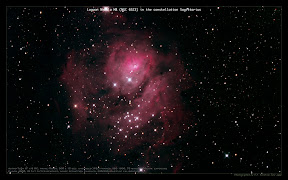
Messier 8, the Lagoon Nebula remix

Okay, once again trying my hand at this beautiful deep sky object. Of all my shoots, this has seemed to be the most troublesome; my recent attempts thwarted by cloud pirates and processing gremlins. This time the odds are better with significant improvements:
  • polar alignment using setting circles and computed transit time
  • better dynamic range and less noise than previous DSLR
  • IR-cut filter removed
  • field flattener lens adapter
  • images normalized prior to stacking
  • new DDP algorithm rather than traditional "stretching"
  • nearly doubled the number of exposures taken

You be the judge. 300 x 15-sec. unguided JPEG frames, nearly 75 minutes of overall exposure, modified-Canon XTi, field flattener, calibrated, and processed with DDP.

Monday, July 5, 2010

Messier 23

Back in Tucson under a beautiful night sky for the Fourth of July! Here is Messier 23, an open cluster in the constellation of Sagittarius; one more in my quest to capture every Messier object.


This is very close, cosmologically speaking, only a couple thousand light-years away and upwards of 20 light-years across. Taken with DSLR @ 1600 ISO, unguided, 190 x 15 sec. JPEG frames, calibrated 200/200 bias/flat, and finished processing without "stretching". Instead, out of curiosity, the Digital Development Processing (DDP) feature of Nebulosity was used.

From what I've read, DDP makes digital images more like film and was invented by Kunihiko Okano, a physicist and amateur astronomer. I compared my results with some manual stretching and found I preferred the DDP output. Threw in a some sharpening and color balance - voila.

Sunday, May 16, 2010

Messier 82, Cigar Galaxy

A new personal record, 400 frames! The whole lot taken in just under 5 hours during a good night of extended darkness. This galaxy gets its unusual shape from an exceptionally high rate of star formation, a process called starburst [wiki].

To add to this one's mystery, in April of this year, radio astronomers in Manchester reported a strange new object in M82. A 'micro quasar' was suggested, highly luminous and fairly stable. Some associate this with a massive black hole system, but not at the galaxy's center. The object is several arcseconds off center and an apparent motion of 4x the speed of light!

Yes, you read right, FOUR times the speed of light....warp speed, Scotty!

Wednesday, May 5, 2010

Casitas de Gila

An astronomer's getaway, that's what it is. Many thanks to the proprietors, Michael and Becky, of this quiet mountain retreat just outside the small town of Gila, New Mexico. What a fantastic way to spend quality time with your telescope!

Large open areas to setup, easy access to power, and the basic comforts the casitas provide including refrigeration for your foodstuffs. If you choose to indulge in this experience, please plan to bring your perishables in with you as the nearest grocery is over an hour away. A small convenience store is 4 miles back in Gila...but that's it.

Arrived on Thursday the 29th and stayed through Saturday night May 1st. Though the timing wasn't so great for dark skies, the clouds and Moon were absent for a couple hours where I could try out my scope.

Decided to retake Messier 13, the Great Cluster in the constellation Hercules. Comparatively, I have to say even with only 152 unguided frames, the results of this location impressed me. Nestled in a location with a Bortle Dark-Sky rating of 2, we were somewhere around 6000ft. above sea level.

This photo is comprised of 152 x 15 sec. unguided JPEG frames at ISO 1600, taken with a modified Canon 450D and field flattener. Created new bias and flats for this outing, 200 apiece.

We'll be back here again soon!

Friday, February 19, 2010

M104 up close and personal...

Jeepers, the Sombrero Galaxy doesn't look so bad for bumbling around with this big tube, fair atmospheric transparency, and then rolling clouds coming in to keep me to just 150 frames rather than the 250 frames planned. Unguided, 156 x 15 sec JPEG frames at 1600 ISO, noise reduction enabled, modified Canon Rebel XSi. Just stacked and stretched. Will try a little bias preprocessing to see if it helps a bit on the noise, I pushed this one pretty hard.

Thursday, February 18, 2010

Bigger is better...

Well, especially when it comes to telescope aperture. Decided to take
my 10" Dobsonian (Newtonian) optical tube and put it up on the Atlas
equatorial mount. A couple tube rings and Voila! Turns out I need a
little more weight to stay balanced, but once that problem is solved
we'll see if this monstrosity is up to the tracking challenge.

I'm excited to see what the impact to my unguided astrophotographs will be! All my shots to date have been with nothing larger than 6" aperture. Just need those counterweights...

Thursday, January 21, 2010

Waiting on the weather...

Wow, since after Thanksgiving the weather has really not played nice
with timing of dark nights. Just entering a bright Moon period, now.
Anxious for a break, this is the season for galactic clusters. Let's
go, let's go, let's go...

Monday, November 23, 2009

Saturday, November 21, 2009

New MoonLite focuser rig

The old Astro-Tech Crayford focuser that came with scope had issues when it came to keeping the drawtube square with the focusing assembly. Off-center position when locked down induced coma-like effects, made star alignment difficult, and fine focus was problematic. In short, it was just a cheap focuser.

Enter the new MoonLite focuser. In addition to being a solid piece of machined hardware, the primary benefit is that the drawtube is locked in position by applying pressure to the focusing shaft, not the drawtube itself.

Tried it out and focusing was a pleasure! Looking forward to using this from now on.